Data Visualization
Birthday Paradox Simulator
Most people guess you need hundreds of people before two share a birthday. This simulator fills virtual rooms with random birthdays, counts the matches and shows the results closing in on the real probability.

 Source code
600 simulated rooms landed within 3% of the exact probability.
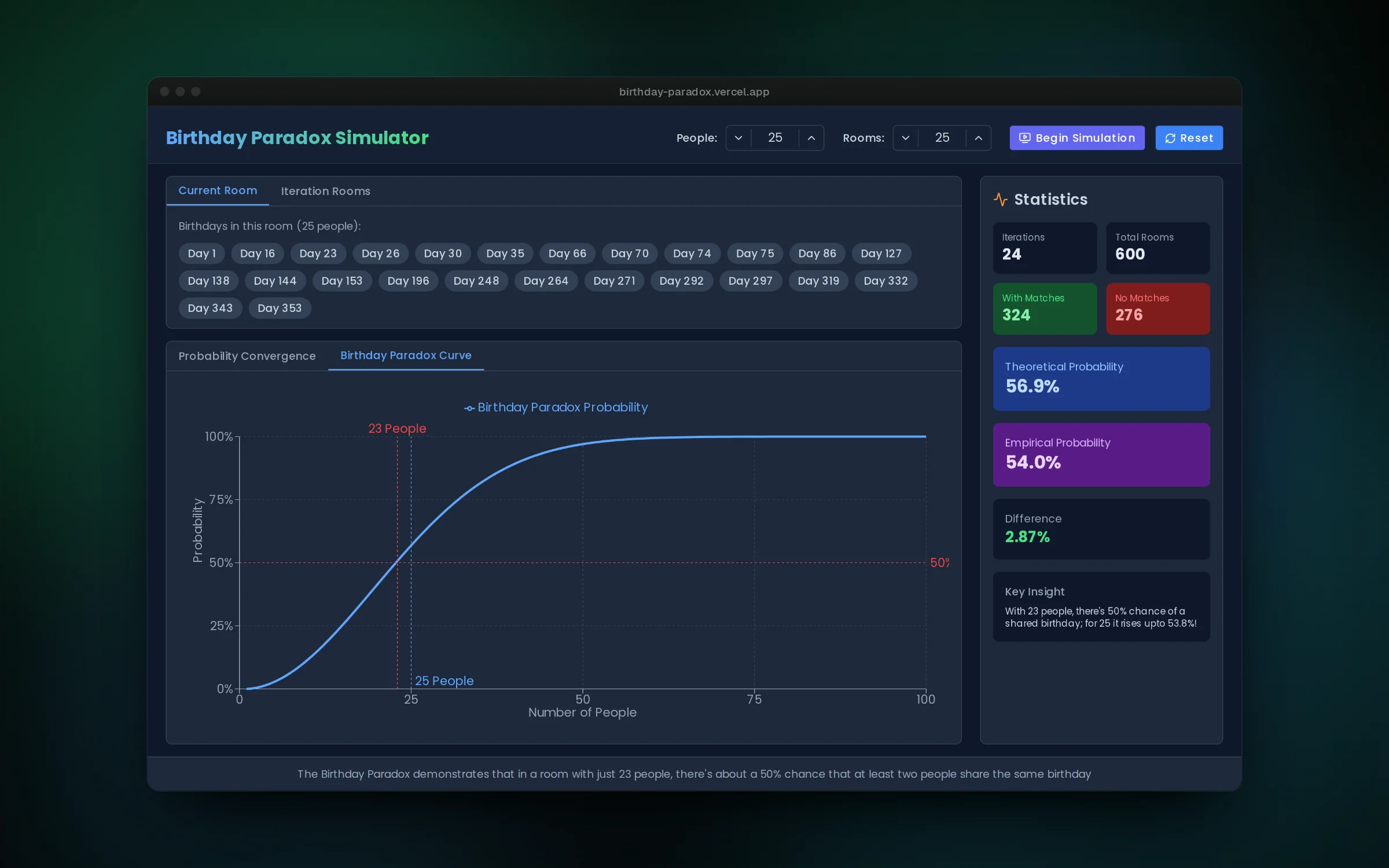
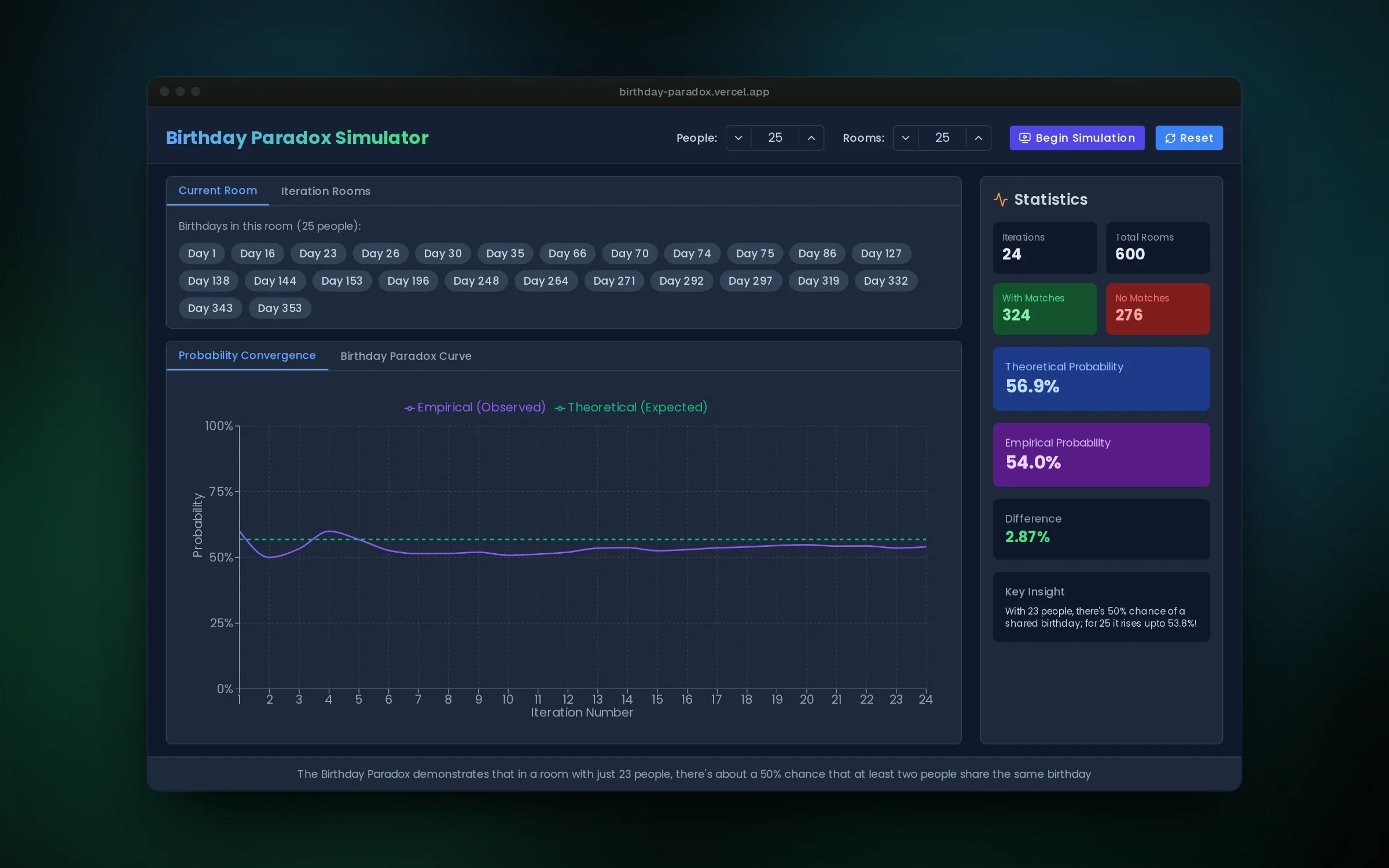
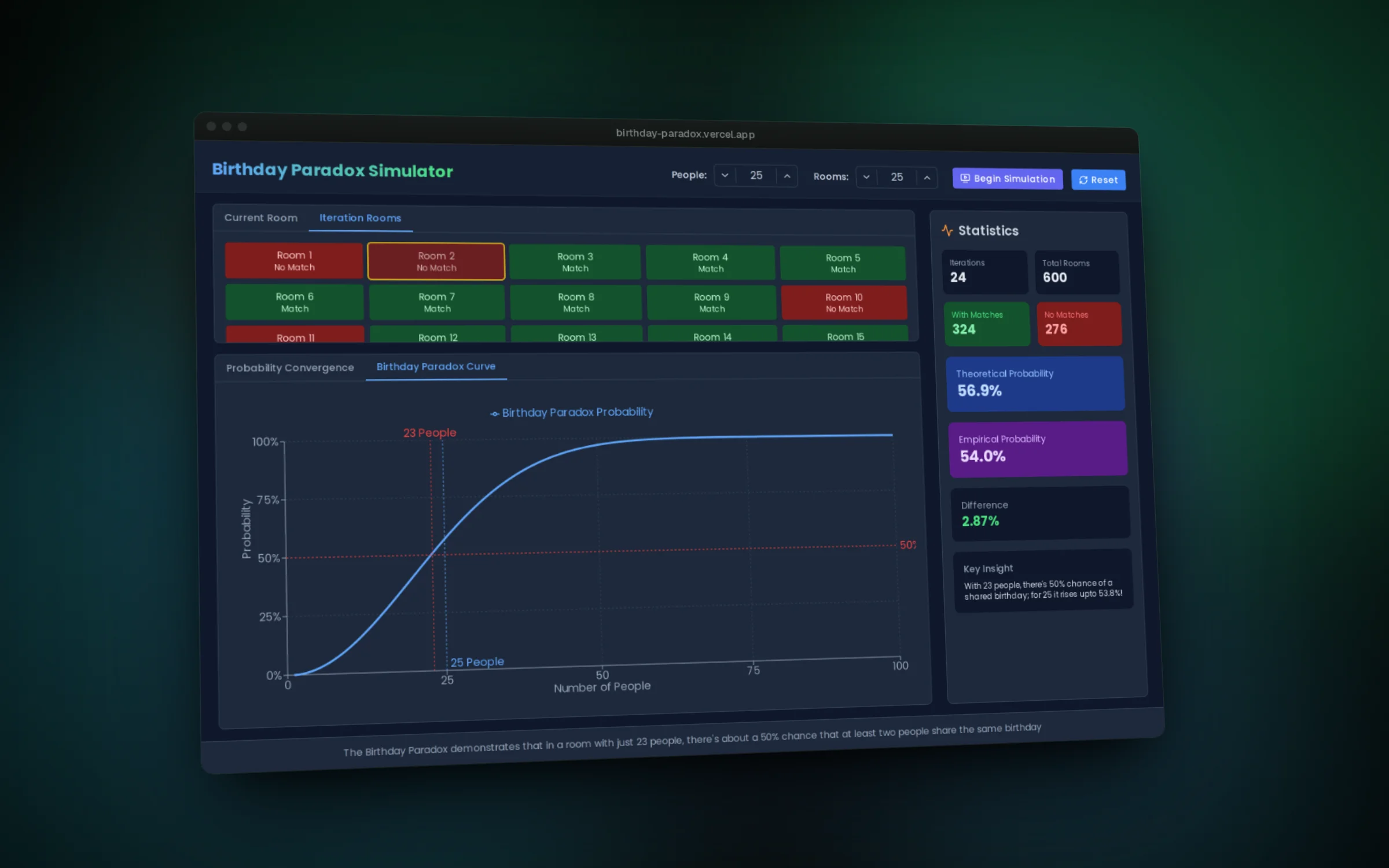
01 / 04The chance of a shared birthday passes 50% at 23 people
Overview
The birthday paradox says that in a room of just 23 people there is about a 50% chance that two share a birthday. It sounds wrong because we think about one person matching us, not about every possible pair in the room.
Instead of asking you to trust the formula, the simulator runs the experiment. You choose how many people go in each room and how many rooms to generate, then press start. Each round fills the rooms with random birthdays, highlights the matches and adds the result to a running total.
One chart shows the observed rate settling onto the theoretical line. Another plots the full curve from 1 to 100 people, with 23 marked where it crosses 50%.
Features
- Set the number of people per room and rooms per round
- Run the simulation continuously and stop it at any time
- See each room's birthdays with shared days highlighted
- Browse every room in a round, marked match or no match
- Compare observed and theoretical probability as the rounds add up
- Explore the full probability curve for group sizes up to 100
Challenges
- Computing the exact probability without huge factorials by multiplying the chance of no match one person at a time
- Running rounds on a timer while keeping charts and counters in sync without freezing the page
- Keeping the convergence chart readable as hundreds of rooms pile up
- Explaining the result in plain words next to the numbers, so the charts make sense to non-mathematicians